
Torre Santa Sabina
- Published in Posti da Visitare
TERRITORIO
Torre Santa Sabina è una frazione, situata sulla costa adriatica dell'alto Salento, del comune di Carovigno, in provincia di Brindisi.
STORIA
Già frequentato nell'Età del Bronzo, il sito venne utilizzato fin dal VII secolo a.C. come scalo portuale dell'antica città messapica di Karbina (Κάρβινα), che sorgeva presso l'odierna Carovigno, come attestano frammenti ceramici rinvenuti sui fondali. Si trattava di un porto di notevole importanza, avendo una cava di pietra aperta proprio in prossimità della costa, quindi una zona ampiamente battuta dalle navi che trasportavano mercanzie, soggetta ai traffici commerciali tra la Grecia e le città dell'Italia meridionale.
In epoca imperiale fu sede della stazione di sosta detta Ad Speluncas (così chiamata per via delle grotte presenti in zona), ubicata lungo la Via Traiana.[8] In periodo bizantino il suo territorio era cosparso di insediamenti rupestri e il nome di Santa Sabina deriverebbe dal culto dedicato a questa santa in una delle cripte allora esistenti. Nel XIII secolo si insediarono nella contrada i Cavalieri Teutonici, e vi costruirono un ospedale e forse la prima torre: un inventario di Raimondo Orsini del Balzo della fine del Trecento menziona infatti in questa località una torre distrutta.
Studi sul territorio[ suggeriscono che l'area sia stata colpita da due maremoti: uno data 6 aprile 1667 e fu originato dal terremoto che distrusse Ragusa di Dalmazia; un secondo tsunami flagellò le coste il 20 febbraio 1743 ed ebbe come epicentro il Canale d’Otranto.
LA TORRE
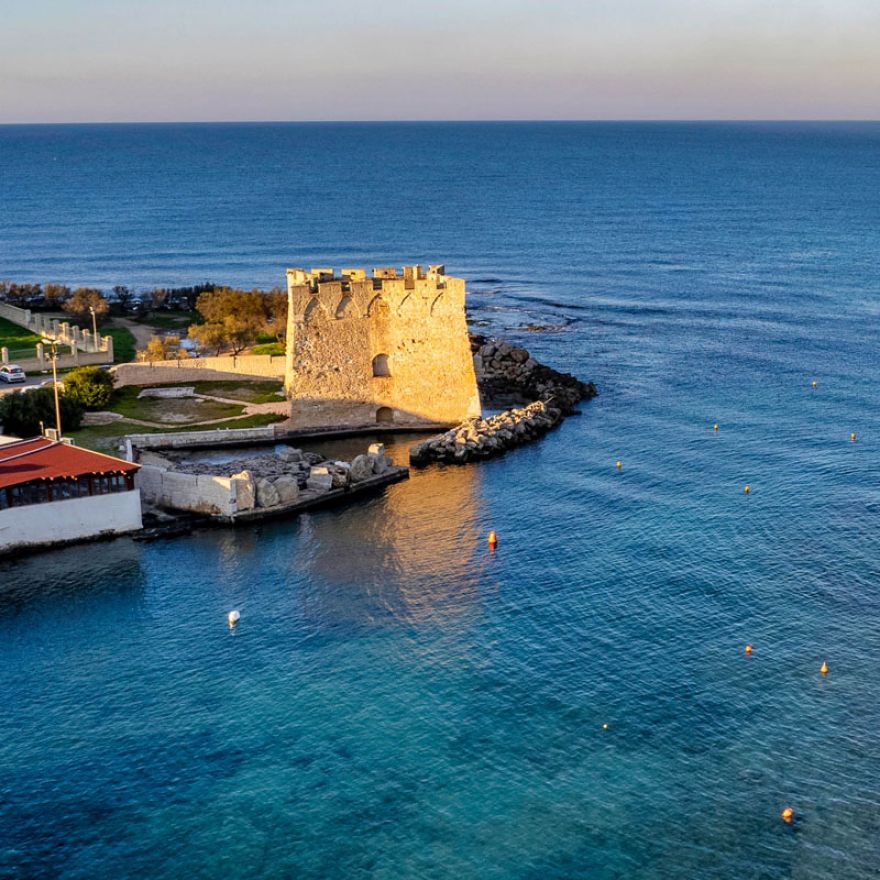
La torre di Santa Sabina è una delle tre torri a forma ottagonale "a cappello da prete" del Sud-Italia, oltre a quelle di Cofano e di San Pietro in Bevagna. In particolare la torre di Santa Sabina ha forma stellare a quattro spigoli orientati verso i punti cardinali, con coronamento merlato. Fu edificata, con ogni probabilità, tra la fine del XV e l'inizio del XVI secolo, come torre di controllo del porticciolo, dai feudatari di Carovigno; venne poi demanializzata dalla Regia Corte sul finire del Cinquecento secondo le disposizioni del viceré Pedro Afán de Ribera entrando a far parte del circuito di torri di avvistamento antisaraceno. È infatti collegata visivamente con Torre Pozzelle a nord e con Torre Guaceto a sud, che comunicavano tra loro attraverso un piccolo falò acceso dai soldati quando avvistavano in lontananza il nemico proveniente dal mare, in particolare le incursioni turche.
Nella seconda metà dell'Ottocento la torre, che aveva ospitato un ufficio della Regia Dogana, versò in stato di abbandono. Ritornò in mani private nel 1915, quando fu acquistata dalla famiglia Dentice di Frasso che la ristrutturò e la vendette in seguito ad altri privati.
TURISMO
Località prettamente dedita al turismo balneare, Torre Santa Sabina – Marina di Carovigno – conta qualche decina di abitanti durante il resto dell'anno. Presenta diverse strutture alberghiere e numerosi ristoranti, bar e pub frequentati dalla popolazione dell'entroterra e meta di turisti italiani e stranieri, tanto da essere considerata il luogo elettivo della movida carovignese.
Il porticciolo naturale, situato nelle immediate vicinanze della torre, ospitava alcune imbarcazioni di pescatori. Accanto ad esso si stende un'ampia baia con spiaggia di sabbia, e non molto lontano una piccola pineta.
Nel borgo è presente una Chiesa Rettoria Santa Sabina, che dipende dalla Parrocchia S. Pietro Apostolo di Carovigno.
Nel 2007, e dal 2016 in poi, al comune di Carovigno, coi suoi 14 km di costa (tra basse scogliere, calette e grandi spiagge), è stata assegnata la Bandiera Blu.
TERRITORY
Torre Santa Sabina is a hamlet, located on the Adriatic coast of Salento, in the municipality of Carovigno, in the province of Brindisi.
HISTORY
Already frequented in the Bronze Age, the site was used since the seventh century B.C. as a port of call of the ancient Messapian city of Karbina (Κάρβινα), which stood at today’s Carovigno, as evidenced by ceramic fragments found on the seabed. It was a port of considerable importance, having an open stone quarry right next to the coast, therefore an area widely frequented by ships carrying merchandise, subject to trade between Greece and the cities of southern Italy.
In imperial times it was the seat of the station called Ad Speluncas (so called because of the caves in the area), located along the Via Traiana. [8] In the Byzantine period its territory was strewn with rocky settlements and the name of Santa Sabina derives from the cult dedicated to this saint in one of the crypts then existing. In the thirteenth century the Teutonic Knights settled in the district, and they built a hospital and perhaps the first tower: an inventory of Raimondo Orsini del Balzo of the late fourteenth century in fact mentions in this town a destroyed tower.
Studies on the territory[ suggest that the area was hit by two tidal waves: one dated 6 April 1667 and was originated by the earthquake that destroyed Ragusa of Dalmatia; a second tsunami struck the coast on 20 February 1743 and had as its epicenter the Otranto Canal.
LA TORRE
The tower of Santa Sabina is one of the three octagonal "priest’s hat" towers of South-Italy, as well as those of Cofano and San Pietro in Bevagna. In particular, the tower of Santa Sabina has a stellar shape with four edges oriented towards the cardinal points, with crenellated crowning. It was built, in all likelihood, between the end of the fifteenth and the beginning of the sixteenth century, as a control tower of the marina, by the feudal lords of Carovigno; It was then assigned by the Royal Court at the end of the sixteenth century according to the provisions of Viceroy Pedro Afán de Ribera, becoming part of the circuit of anti-arachnoid towers. It is in fact visually connected with Torre Pozzelle to the north and with Torre Guaceto to the south, which communicated with each other through a small bonfire lit by soldiers when they saw in the distance the enemy coming from the sea, in particular the Turkish raids.
In the second half of the nineteenth century the tower, which had housed an office of the Regia Dogana, fell into a state of neglect. It returned in private hands in 1915, when it was bought by the Dentice family of Frasso who restructured it and sold it to other individuals.
TOURISM
A resort dedicated to beach tourism, Torre Santa Sabina - Marina di Carovigno - has a few dozen inhabitants during the rest of the year. It has several hotels and numerous restaurants, bars and pubs frequented by the population of the hinterland and a destination for Italian and foreign tourists, so much so that it is considered the elective place of carovignese nightlife.
The natural harbour, located in the immediate vicinity of the tower, housed some fishing boats. Next to it lies a large bay with sandy beach, and not far away a small pine forest.
In the village there is a Rectory Church Santa Sabina, which depends on the Parish St. Peter Apostle of Carovigno.
In 2007, and from 2016 onwards, the town of Carovigno, with its 14 km of coastline (between low cliffs, coves and large beaches), was awarded the Blue Flag.